



Microwave & RF Printed Circuit Boards
To meet increasing global demand for microwave and RF printed circuit boards, Epec has expanded its investment in equipment, materials, and processes to support high-frequency PCB manufacturing. Microwave and RF PCBs are defined by their ability to carry RF or microwave signals, with operating frequencies typically ranging from 50 MHz to above 2 GHz. These frequency ranges introduce unique electrical, thermal, and mechanical challenges that distinguish RF and microwave boards from traditional digital PCBs.
These applications require high frequency laminates with performance characteristics that exceed standard FR4 materials. With extensive experience working with PTFE-based microwave laminates, Epec understands the tight tolerances and high reliability requirements common to RF and microwave designs.
These applications typically require laminates with specialized electrical, thermal, mechanical, or other performance characteristics that exceed those of traditional standard FR-4 materials. With our many years of experience with PTFE-based microwave laminate, we understand the high reliability and tight tolerance requirements of most applications.
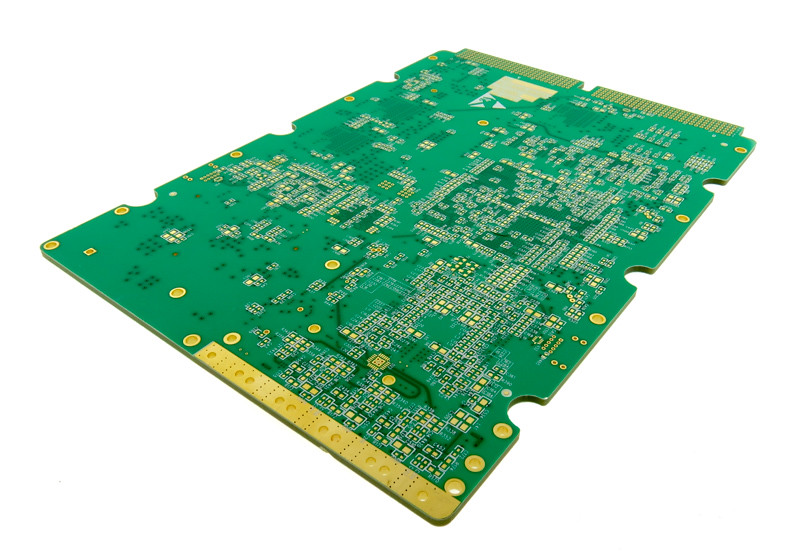 Selective solder mask on a RF circuit boards design.
At a Glance: Microwave & RF PCBs
- Microwave and RF printed circuit boards are designed to carry high-frequency signals, typically from 50 MHz to above 2 GHz, requiring tight impedance control and specialized laminate materials beyond standard FR4.
- Epec manufactures RF and microwave PCBs using PTFE-based and other high-frequency laminates, supported by hybrid stack-ups, inhouse precision machining, and specialized processing equipment.
- Capabilities support demanding applications such as antennas, radar, high-frequency communications, test and measurement systems, aerospace and defense, and medical RF devices.
PCB Material Stock and Hybrid Stack-Ups
Certain RF and microwave PCBs incorporate both FR4 and PTFE or other high-frequency materials within the same stack-up. These designs are commonly referred to as hybrid PCBs. Hybrid circuit board constructions allow designers to balance electrical performance, size, and overall cost while meeting frequency-specific requirements.
Epec maintains relationships with key material suppliers, including Rogers, Arlon, Nelco, and Taconic. Due to the specialized nature and cost of these laminates, few manufacturers keep inventory on hand. Epec stocks significant quantities of Rogers 4003 and 4350 series materials, as well as Arlon products, to support faster response times for RF and microwave PCB programs.
RF & Microwave PCB Design Considerations
High-frequency circuit boards are challenging to design due to signal sensitivity and the need to manage thermal performance. Many high-frequency PCB materials exhibit lower thermal conductivity compared to standard FR4, which must be considered during layout and stack-up planning.
RF and microwave signals are especially sensitive to noise and require much tighter impedance tolerances than digital circuits. Design techniques such as the use of ground planes and generous bend radii on impedance-controlled traces help optimize performance. Because wavelength is dependent on frequency and material properties, higher dielectric constant (Dk) materials can enable smaller PCB designs for specific impedance and frequency ranges.
Dielectric Properties and Material Selection
Understanding PCB material characteristics such as dielectric constant, coefficient of thermal expansion, thermal coefficient, temperature coefficient of dielectric constant, dissipation factor, relative permittivity, and loss tangent is critical to creating robust RF PCB designs. These parameters directly affect signal integrity, size, and long-term reliability.
High-Dk laminates, often with Dk values of 6 or higher, are sometimes combined with lower-cost FR4 materials in hybrid multilayer designs. This approach allows designers to meet electrical performance requirements while controlling overall board size and cost.
High-Frequency Laminate Experience
Epec has experience with a wide range of high-frequency materials. Ceramic-filled PTFE composites offer strong electrical and mechanical stability. Rogers RO3000 series materials maintain consistent mechanical properties across different dielectric constants, supporting multilayer designs without warpage or reliability issues.
The Taconic RF series provides low dissipation factor and can achieve higher thermal conductivity, avoiding oxidation, yellowing, or upward drift in dielectric properties. Other supported materials include ultra-low loss, heat-resistant, halogen-free Megtron 6, which is suitable for high-density interconnect and high-speed constructions above 3 GHz.
Woven glass reinforced PTFE laminates, such as the Taconic TL family, offer improved dimensional stability and low dissipation factor, making them well-suited for millimeter-wave and radar applications at frequencies such as 77 GHz. Hydrocarbon ceramic laminates, including Rogers RO4000 series, provide low loss with thermal conductivity values between 0.6 and 0.8 and Dk ranges from 2.55 to 6.15.
Thermoset microwave laminates, such as Rogers TMM materials, combine low thermal coefficient of dielectric constant with copper-matched expansion for mechanically reliable strip-line and microstrip applications. Many additional materials are supported, enabling RF and high-speed PCB designs tailored to specific requirements.
Competitive Material Matrices
Quick-reference competitive material matrices compare best-fit alternatives from Taconic, Panasonic Megtron, and AGC. These materials are not drop-in replacements. Final designs should always be verified against manufacturer datasheets for stack-up, dielectric properties, copper selection, and processing requirements.
Isola Competitive Matrix
| Resin System | Category | Dk @ 10 GHZ | Df @ 10 GHz | Competitors | Product Name | Dk | Df |
|---|---|---|---|---|---|---|---|
| I-Speed | Low Dk/Df | 3.64 | 0.0094 | Panasonic | Megtron 4 | 3.80 | 0.0050 |
| TUC | Thunderclad | 3.90 | 0.0095 | ||||
| AGC/NELCO | N4800-20 | 3.80 | 0.0075 | ||||
| AGC/NELCO | Meteorwave 1000 | 3.70 | 0.0055 | ||||
| Doosan | DS-7409D (X) | 3.80 | 0.0050 | ||||
| I-TeraMT40 | Very Low Dk/Df | 3.30 | 0.0036 | Panasonic | Megtron 6 | 3.61 | 0.0040 |
| AGC/Neclo | Meteorwave 2000 | 3.40 | 0.0040 | ||||
| AGC/Neclo | Meteorwave 3000 | 3.80 | 0.0048 | ||||
| Rogers | RO4350B | 3.48 | 0.0037 | ||||
| TUC | TU-993 | 3.40 | 0.0025 | ||||
| Doosan | DS-7409D (V) | 3.65 | 0.0015 | ||||
| I-TeraMT40 RF | RF | 3.45 | 0.0031 | Rogers | RO4350B | 3.48 | 0.0037 |
| Arlon | AD350 | 3.50 | 0.0030 | ||||
| Taconic | RF35 | 3.50 | 0.0025 | ||||
| AGC/Neclo | NH9350 | 3.50 | 0.0030 | ||||
| Tachyon-100G | Ultra Low Dk/Df | 3.00 | 0.0021 | Panasonic | Megtron 7N | 3.35 | 0.0020 |
| AGC/Neclo | Meteorwave 4000 | 3.50 | 0.0040 | ||||
| EMC | EM-891K | 3.10 | 0.0033 | ||||
| Doosan | DS-7409DV(N) | 3.35 | 0.0010 | ||||
| AstraMT77 | RF | 3.00 | 0.0017 | Rogers | RO3003 | 3.0 | 0.0013 |
| Arlon | AD300C | 3.0 | 0.0020 | ||||
| AGC/Neclo | NX9300 | 3.0 | 0.0023 |
There are many more materials available, which we have experience with so if you don’t see what you are looking for listed, send us a request for more information and we can help you design an RF or high-speed PCB to meet your requirement.
Rogers Competitive Matrix
| Rogers laminate | Typical Dk | Key Benefits | Competitive Materials (Taconic / Panasonic Megtron / AGC) |
|---|---|---|---|
| RO4003C | 3.38 | Low loss, FR-4-like processing for RF; tight Dk control. | Taconic RF-35; Panasonic Megtron 6; AGC Nelco N4000-13 SI. |
| RO4350B | 3.48 | Low loss hydrocarbon-ceramic; cost-effective microwave. mcl | Taconic RF-35; Panasonic Megtron 6; AGC Nelco N4000-13 SI. |
| RO4835 | 3.48 | Low loss with enhanced oxidation resistance and stability. | Taconic RF-35TC; Panasonic Megtron 6; AGC Nelco N4000-13 SI. |
| RO4700 Antenna Grade | 2.55 or 3.0 | Antenna-grade, cost-optimized vs PTFE antennas. | Taconic TLX-9 or TLY-5; Panasonic Felios LCP; AGC Taconic TLX/TLY family. |
| RO3003 | ~3.00 | Very low loss PTFE composite, stable to 77 GHz. | Taconic TSM-DS3; Panasonic Megtron 7 or 6; AGC Nelco N4000-13 SI. |
| TMM series (TMM3…TMM13i) | varies | Thermoset microwave, very low TCDk, copper-matched CTE. | Taconic CER series eg CER-10; Panasonic Megtron 6 or 7; AGC Nelco N4000-13 family. |
| RT/duroid 5880 | ~2.20 | Ultra-low Dk/PTFE, very low Df for broadband RF. | Taconic TLY-5; Panasonic Felios LCP; AGC Taconic TLY family. |
| RT/duroid 6002 | ~2.94 | Low loss, tight thickness, in-plane CTE matched to Cu. | Taconic TSM-DS3 or TLX/TLE-95 class; Panasonic Megtron 7; AGC Nelco N4000-13 SI. |
| RT/duroid 6035HTC | ~3.50 | High thermal conductivity for high-power RF. | Taconic RF-35TC; Panasonic Megtron 6; AGC Nelco N4000-13 SI. |
| RT/duroid 6006 / 6010.2LM | 6.15 / 10.2 | High-Dk for size reduction, reliable PTH. | Taconic RF-60A or CER-10; Panasonic Megtron 6; AGC Nelco N4000-13 series. |
The above table is a quick-reference for the closest competitive materials from Taconic, Panasonic Megtron, or AGC. These are best-fit alternatives, not drop-in equivalents. You should always confirm stack-up, Dk/Df, copper, and processing requirements against the datasheets.
Specialized Processing Equipment
While microwave and RF PCB fabrication can be performed using standard equipment, demanding designs often require specialized processing. Epec maintains inhouse plasma etching to prepare through-holes and improve plating quality, laser direct imaging for tight trace widths and precise front-to-back registration, and laser drilling to prevent material damage common with mechanical drilling. These investments support consistent production of high-quality micro-vias and complex RF features.
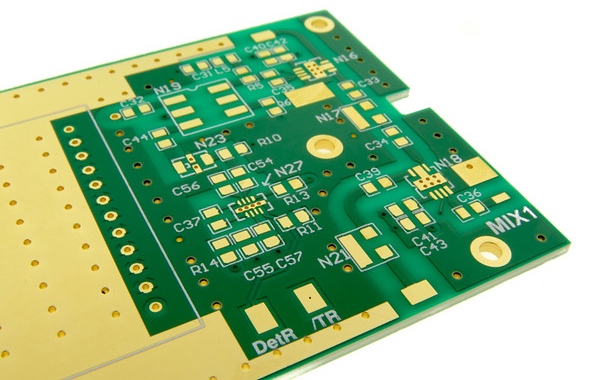
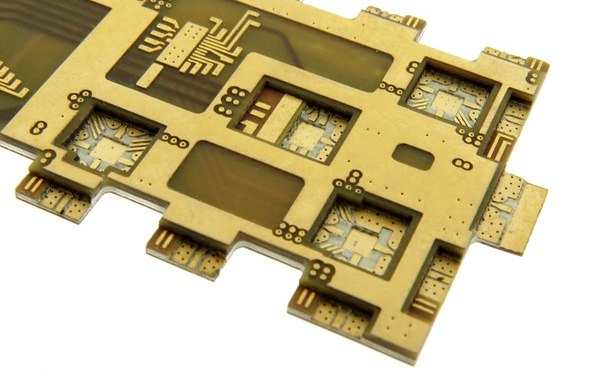
Castellated Edges for RF and Microwave Boards
Epec uses a specialized inhouse process to manufacture castellated edges, delivering strong mechanical attachment and reliable electrical performance. For designs requiring larger mounting or board-to-board interface holes, a proprietary process combines precision drilling, selective half-hole plating, and edge routing to maintain alignment under tight tolerances.
Smaller boards and fine-pitch applications utilize a high-precision dicing saw process. This method cleanly forms half-holes with minimal distortion and consistent edge quality, supporting sensitive RF modules where signal integrity and mechanical reliability are critical.
Key benefits of controlled castellated edge processing include:
- Structural integrity through prevention of copper delamination and plating drag
- Reliable soldering with clean, accurately aligned half-holes
- Manufacturing consistency through complete inhouse process control

Wide Ranging Capabilities
In addition to standard microwave and RF PCBs, PTFEbased processing capabilities include:
- Hybrid PTFE and FR4 constructions
- Metal-backed and metal-core PCBs
- Mechanically and laser-drilled cavity boards
- Edge plating and complex board outlines
- Front-to-back registration of etched cores to ±0.002 inches
- ±0.001-inch tolerance on etched features for unplated 1 oz copper
- Blind and buried vias, viainpad, microvias, stacked vias, and laser vias
- Soft gold and ENEPIG plating
- Sequential lamination
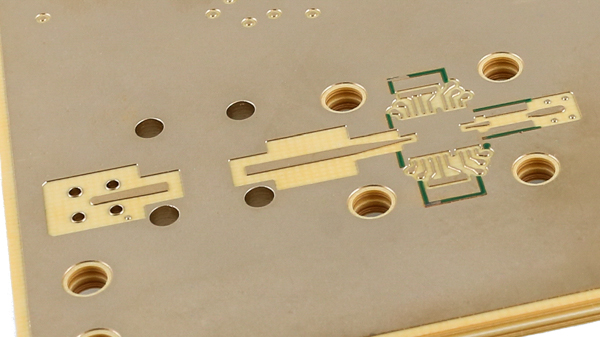 Selective solder mask on a RF circuit boards design.
Our Application Experience
- Antenna Systems: Experience includes patch, phased array, GPS, microwave backhaul, and millimeter-wave antenna designs for satellite, radar, and communications systems.
- Radar & Sensing: Supported designs include automotive radar modules at 24 GHz and 77 GHz, air traffic control, weather radar, and ground-penetrating radar systems.
- High-Frequency Communication Modules: Applications include satellite transceivers, upconverters and downconverters, VSAT terminals, point-to-point radios, and Kaband, Kuband, and Xband RF front ends.
- Test & Measurement Equipment: Manufacturing experience includes RF boards for vector network analyzers, spectrum analyzers, signal generators, oscilloscopes, RF power meters, noise figure analyzers, and portable field analyzers.
- RF Power & Amplification: Capabilities cover low noise amplifiers, power amplifiers, combiners, splitters, driver amplifiers, GaN-based amplifiers, Doherty amplifiers, and PCB control circuitry for traveling wave tube amplifiers.
- Filters & Couplers: Supported designs include cavity filters, directional couplers, diplexers, microstrip filters, Wilkinson dividers, hybrid couplers, tunable filters, baluns, and duplexers.
- Aerospace & Defense: Experience includes missile guidance RF sections, electronic warfare systems, and communication systems used in aircraft and spacecraft.
- Medical: Applications include MRI RF coils, matching networks, and medical telemetry systems.
Microwave & RF PCB Specifications
| Parameter | Value | Units |
|---|---|---|
| RF / microwave signal frequency range | 50 MHz to >2 | GHz |
| High-speed material suitability | Above 3 | GHz |
| Radar application frequency | 77 | GHz |
| RO4000 series dielectric constant range (Dk) | 2.55–6.15 | — |
| RO4000 series thermal conductivity | 0.6–0.8 | — |
| Front-to-back registration tolerance | ±0.002 | inches |
| Etched feature tolerance (unplated 1 oz Cu) | ±0.001 | inches |
Frequently Asked Questions
Quick Links
- What defines a microwave or RF PCB?
- Why are high-frequency laminates needed instead of standard FR4?
- What is a hybrid RF PCB?
- Why is impedance control critical for RF PCBs?
- How do dielectric properties affect RF PCB design?
- What applications commonly use microwave and RF PCBs?
What defines a microwave or RF PCB?
These PCBs carry RF or microwave signals, typically operating from 50 MHz to above 2 GHz, which drives specialized design and material requirements.
Why are high-frequency laminates needed instead of standard FR4?
Microwave and RF applications require electrical, thermal, and mechanical properties that exceed the performance of standard FR4 materials.
What is a hybrid RF PCB?
Hybrid PCBs combine FR4 and PTFE or other high-frequency materials within the same stack-up to balance performance, size, and cost.
Why is impedance control critical for RF PCBs?
RF and microwave signals are highly sensitive to noise and require tighter impedance tolerances than digital circuits to maintain signal integrity.
How do dielectric properties affect RF PCB design?
Material properties such as dielectric constant, dissipation factor, and thermal behavior influence signal loss, board size, and long-term reliability.
What applications commonly use microwave and RF PCBs?
Typical applications include antennas, radar systems, high-frequency communications, test and measurement equipment, aerospace and defense systems, and medical RF devices.
Elevate Your RF & Microwave PCB Performance
Epec Engineered Technologies offers comprehensive in-house manufacturing, material inventory, precision machining, and specialized processing for microwave and RF PCBs. This integrated approach supports high-performance designs, tight tolerances, and reliable production across a wide range of demanding applications.
Request a Quote Request Design Support Request More InformationRequest a FREE Quote!
We are here to help you with all your printed circuit board needs.
Get Your Quote Now! Not Ready for a Quote? Request more info or email us your inquiry.
Free DFM File Check
Submit your PCB data files and we will run a complete DFM check for manufacturability.
Submit Your Data