


Benefits of Flex PCBs for Aerospace, Medical, Military, and Industrial Applications
Flex and rigid-flex circuit technology provides capabilities that exceed those of other interconnect solutions. Key benefits include reduced packaging requirements, improved reliability, enhanced shock and vibration performance, superior high-speed signal integrity, and strong performance in harsh environments. Individually or combined, these attributes address many common design challenges across the electronics industry.
Flex and rigid-flex PCB designs are used across all major market segments and are proven in demanding aerospace, military, and high-reliability medical applications. In many cases, the circuit can be designed to fit the device rather than forcing the device to accommodate the circuit, allowing additional features or functionality in space-constrained designs.
At a Glance: Benefits of Flex PCBs
- Flex and rigid-flex PCBs reduce size, weight, and packaging complexity by replacing multiple PCBs, connectors, and wiring harnesses with a single integrated circuit that fits the device rather than dictating its form factor.
- Integrated flex and rigid constructions improve reliability and durability, reducing interconnect points while withstanding vibration, shock, extreme temperatures, and harsh environmental conditions.
- Material properties enable high-speed signal performance and application versatility, including consistent impedance control, EMI/RF shielding options, and compatibility with high-density components across aerospace, medical, military, and industrial designs.
Key Benefits of Flexible Circuit Technology
Flexible circuit technology supports tighter packaging, improved durability, and greater design freedom. These advantages enable designers to replace traditional wired solutions with integrated circuits that reduce size, weight, and interconnect complexity while maintaining the same circuit density and precision as rigid PCBs.
Reduced Package Requirements
Flex circuits can be designed to fit where other interconnect solutions cannot. On average, they require only about 10% of the space of comparable wired solutions. Their ability to bend, fold, or crease allows placement into compact or irregular areas, enabling 3D packaging geometries and continued miniaturization.
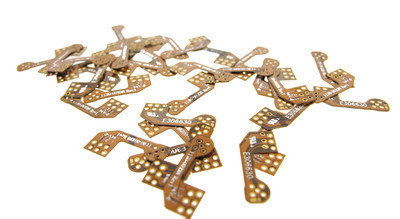
Replacing multiple rigid PCBs, connectors, and wiring harnesses with a single integrated flex circuit reduces overall board count and frees additional space within the finished assembly.
Improved Reliability
Rigid-flex circuits are manufactured as a single integrated unit with no additional interconnect points between rigid sections. This integration significantly reduces the number of solder joints, connectors, crimps, and contacts within a design, lowering the total number of potential failure points.
The ductility and low mass of flex circuits reduce the effects of vibration and shock, improving reliability in mechanically demanding environments. These characteristics make rigid-flex technology well suited for high-reliability military and medical devices.
Reduced Weight
Flex circuits weigh, on average, about 10% of comparable wired solutions. Lower circuit mass reduces the total weight of the finished product and improves shock, vibration, and drop-test performance. These savings are particularly valuable in applications where reduced weight directly improves system efficiency.
High-Speed Signal Performance
Flex materials offer low dielectric constant values ranging from 3.2 to 3.4. Their homogeneous construction eliminates dielectric variations caused by glass weave effects found in rigid materials. Consistent material thickness and dielectric behavior support stable impedance control, narrow line widths, and tight spacing for high-density routing and reliable high-speed signal performance.
Harsh Environment Performance
Polyimide-based flex circuits provide excellent resistance to chemicals, moisture, solvents, oils, acids, and bases. They also perform well under UV and radiation exposure. Flex circuits operate across a wide temperature range from -200°C to 400°C and offer exceptional thermal stability.
Additional material benefits include improved heat dissipation, good mechanical strength, high dielectric withstanding voltage above 3kV, and minimal expansion and contraction, making these circuits suitable for extreme operating environments. Flex circuits can be UL94V-0 certified.
EMI & RF Applications
Flex circuits can be easily shielded against electromagnetic and radio-frequency interference. Available shielding options include copper layers, EMI shielding films, and silver ink, allowing designers to tailor protection based on application-specific requirements.
Cost Saving Opportunities
Reduced packaging requirements lead to smaller assembled products and lower total material usage. Integrated flex designs eliminate many connectors and simplify assembly processes, reducing labor requirements, test time, rework, and assembly errors. Because flex circuits contain all the circuitry and current carrying positions established, wire routing mistakes are eliminated.
Component & Connector Compatibility
Flex and rigid-flex circuits support the same component densities as rigid PCBs, including high-density BGA, surface-mount, and plated through-hole components. They also enable additional interconnect options such as ZIF connectors, high-density one-piece connector systems, crimped contacts, and direct solder attachment methods like hot bar soldering.
Key Material and Performance Parameters
| Parameter | Value | Units |
|---|---|---|
| Space required vs. wired solutions | ~10 | % |
| Weight vs. wired solutions | ~10 | % |
| Dielectric constant (DK) | 3.2-3.4 | — |
| Operating temperature range | -200 to 400 | °C |
| Dielectric withstanding voltage | >3 | kV |
Rigid-Flex PCB Applications in Various Industries
Flex and rigid-flex circuits are deployed across industries that demand compact size, reliability, and environmental durability.
- Aerospace Applications: Lightweight construction reduces payload while improving efficiency. Flex circuits also provide durability under extreme conditions for critical aerospace systems.
- Medical Applications: Flex PCBs enable compact, lightweight wearable and diagnostic devices. Their reliability and design flexibility support improved device performance and patient outcomes.
- Military Applications: Rigid-flex PCBs withstand harsh environments and mechanical stress, ensuring consistent operation in mission-critical military equipment.
- Industrial Applications: Flexible circuits support automation, robotics, and industrial controls by providing durability under vibration, temperature extremes, and harsh conditions. Reduced size and weight improve equipment design efficiency while lowering maintenance demands.
The Unmatched Versatility and Reliability of Flex and Rigid-Flex PCBs
Flexible circuit technology delivers a combination of adaptability, durability, and efficiency that supports innovation across aerospace, medical, military, and industrial electronics. As system requirements continue to evolve, the resilience and versatility of flex and rigid-flex circuits make them a foundational solution for modern electronic design.
Frequently Asked Questions
Quick Links
- What are the primary advantages of flex and rigid-flex PCBs?
- How much space do flex circuits save compared to wired solutions?
- Why are rigid-flex circuits more reliable than traditional assemblies?
- How do flex circuits support high-speed signal performance?
- Can flex PCBs operate in extreme environments?
- What components can be used on flex and rigid-flex circuits?
What are the primary advantages of flex and rigid-flex PCBs?
They provide reduced package size, lower weight, improved reliability, better shock and vibration performance, and strong operation in harsh environments.
How much space do flex circuits save compared to wired solutions?
Flex circuits typically require about 10% of the space used by comparable wired interconnects.
Why are rigid-flex circuits more reliable than traditional assemblies?
They reduce interconnect points such as connectors and solder joints, which lowers the number of potential failure locations.
How do flex circuits support high-speed signal performance?
Low dielectric constants and homogeneous material construction provide consistent impedance and eliminate glass weave variations.
Can flex PCBs operate in extreme environments?
Yes. Polyimide flex circuits resist chemicals, moisture, UV, radiation, and operate across a temperature range from -200 °C to 400 °C.
What components can be used on flex and rigid-flex circuits?
They support high-density BGA, SMT, and plated through-hole components, as well as ZIF connectors, crimped contacts, and direct solder attachment methods.
Looking for a Flexible PCB Solution?
Epec supports advanced flex and rigid-flex designs for high-reliability applications by combining material expertise, manufacturing control, and application-driven guidance.
Request a Quote Request Design Support Request More InformationRequest a FREE Quote!
We are here to help you with all your rigid-flex PCB needs.
Get Your Quote Now! Not Ready for a Quote? Request more info or email us your inquiry. Sign Up For a FREE Account
Register today to quote and order your flex & rigid-flex circuit boards online, 24/7.
Ebook - Top 6 Quality Issues Seen in Flex & Rigid-Flex PCBs
 Download Your Copy
... Or Download Our Flex & Rigid-Flex Circuits Design Guide
Free DFM File Check

Submit your flex or rigid-flex PCB data files and we will run a complete DFM check for manufacturability.
Submit Your Data